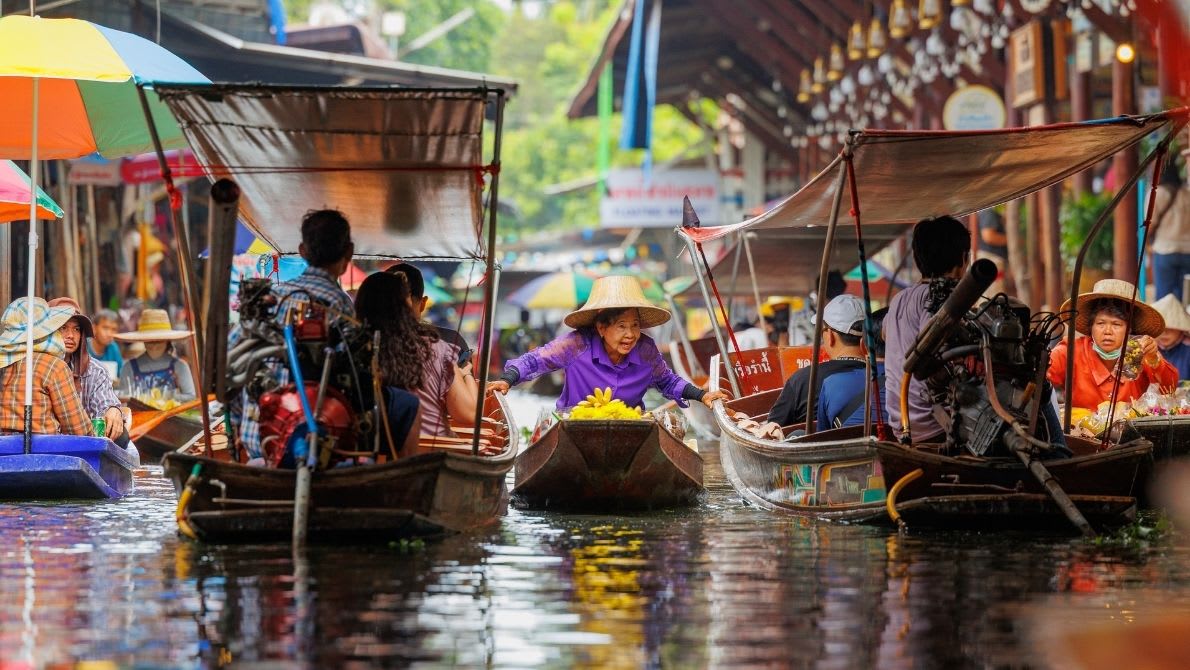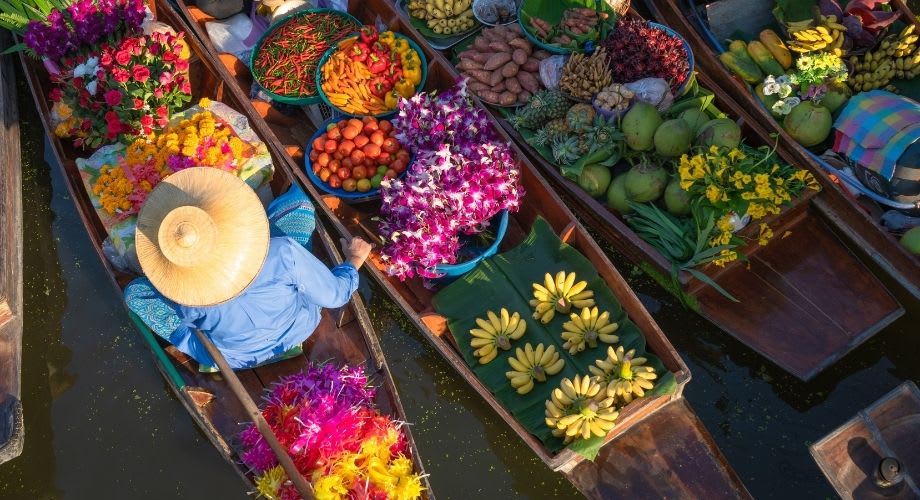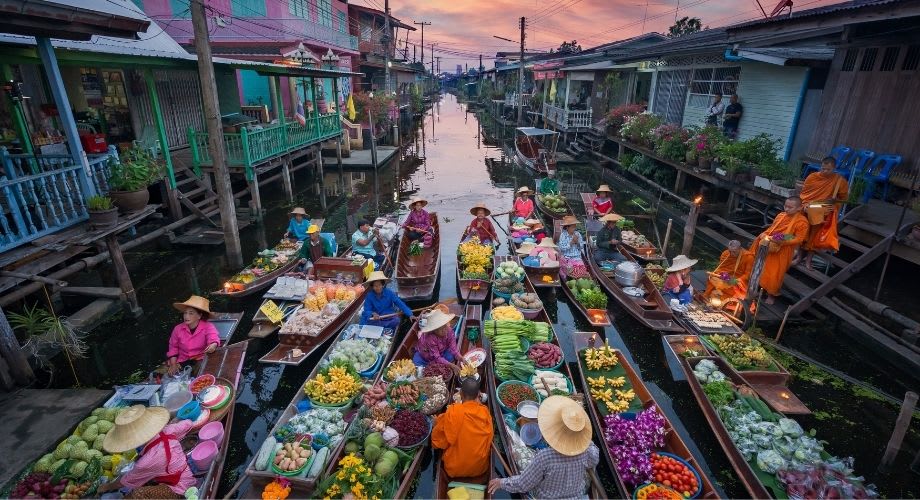
Small wooden boats laden with fresh produce fill up the green canal waters, each steered by a Thai lady in a wide-brimmed straw hat. A melodious din rises from all sides—the hawking of fruit and snacks, the slap and kerplunk of paddles, the chatter of vendors calling from one boat to another…
Such are the images that come to mind when we think of Bangkok’s floating markets. Yet more than picturesque spectacle, these markets are a living continuation of a centuries-old trading culture, when canals, or khlongs, were the lifeblood of the kingdom and buying and selling took place on water as often as on land.
Today, a handful of markets, varying in size and atmosphere, can be found in and around the Thai capital. While few are traditional in a strictly historical sense (most were revived following the decline of canal-based commerce), they still offer a glimpse into how life was once lived among the myriad waterways of central Thailand.
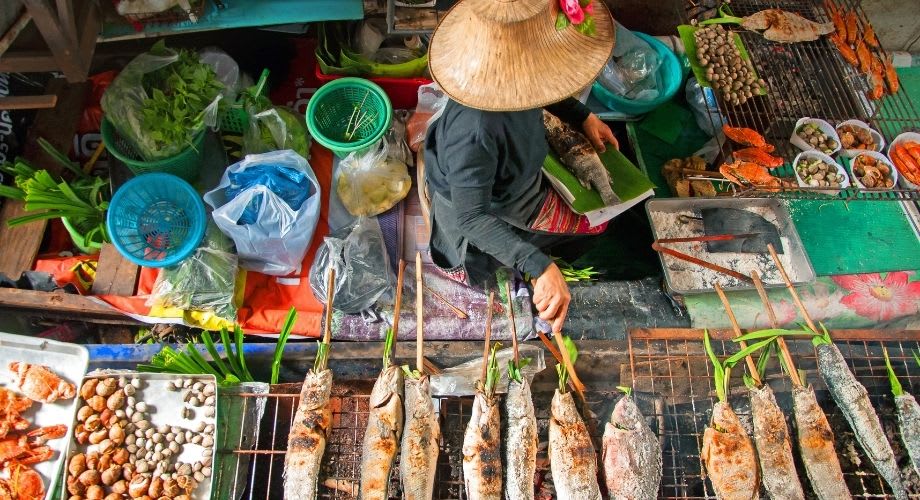
Yet one thing remains undeniably authentic: the food. Think succulent river prawns grilled over charcoal, satay skewers smothered with peanut sauce, and, of course, a variety of spicy mango salads.
Want to know which market deserves a spot on your Thailand itinerary? Cast off on a virtual boat tour and discover the colours, scents, and, above all, flavours of Bangkok’s best floating markets.
History of Thailand’s Floating Markets
But first, a brief history lesson. While today Bangkok is synonymous with gridlocked traffic, this wasn’t always the case—until the mid-20th century, the khlong, not the car, was king.
Across the fertile regions of the Chao Phraya and Mae Klong rivers, farmers transported produce by boat, trading coconuts, rice, and other goods directly from the water in a vast, interconnected network of canals.
From the late 19th century onward, however, sweeping modernisation efforts began to reshape Thailand, then known as Siam. Roads gradually replaced canals, transforming Bangkok from the so-called “Venice of the East” into a fast-expanding metropolis. (Many of the city’s major thoroughfares such as Silom and Asoke were once waterways later filled in.) As these changes took hold, the culture of the floating market all but faded from view.
By the late 20th century, however, floating markets underwent a revival, driven by nostalgia, cultural preservation, and a growing tourism industry. Today, they blend traditional boat-based commerce with bustling land markets, drawing a steady stream of local and international visitors alike, each in search of a glimpse into Thailand’s waterborne past.
Bangkok's Best Floating Markets
Taling Chan Floating Market
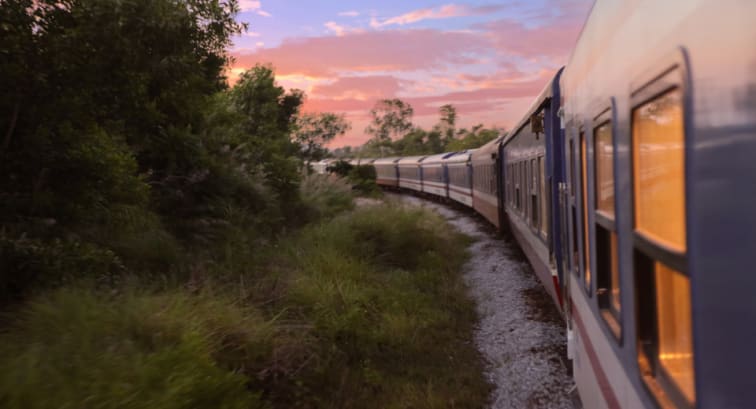
Set in Bangkok’s western Thonburi region, Taling Chan Floating Market is among the easiest to reach, sitting conveniently beside SRT Red Line (which connects to the city’s central terminal) and Thailand’s southern railway line. With the tracks so close, a train is likely to clatter past during your visit, so keep your camera at the ready.
Established in 1987 to preserve the canal-side heritage of Taling Chan—one of Bangkok’s fifty districts—the market is modest in scale, with the trade taking place along a short section of the Chak Phra canal. Here, a handful of vendors prepare “boat noodles” (well-seasoned bowls of noodle soup), or grilled seafood directly from their boats.
Alongside the canal is the larger land-based market housed within a pavilion, where stalls dish up Thai treats such as Khao Tom Mad—glutinous sticky rice with coconut milk and sugar, wrapped in banana leaf—and khanom buang, crispy sweet pancakes with a soft dessert centre. A glass of freshly pressed sugarcane juice goes down nicely as well.
Although the market is easily reached by public transport or by a twenty-minute Grab ride from central Bangkok, a more memorable approach is by canal boat. Departing from the Chao Phraya River, the boat churns along Thonburi’s canals, passing century-old teak mansions, traditional stilted dwellings, Chinese shrines, Buddhist temples and old mosques. The route can also be done in reverse, with shared boats costing around 200 baht.
Khlong Lat Mayom Floating Market
A few kilometres further out, Khlong Lat Mayom Floating Market is a larger, livelier affair, though much of the action now takes place on land.
Founded in 2001 to support local farmers and preserve a rural way of life amid Bangkok’s ever-creeping sprawl, the market spans several zones, each packed with food stalls that will leave you overwhelmed with choice. Expect deep-fried sesame balls, skewered meats, salt-crusted tilapia and grilled snakehead (tastier than its name suggests!), and, of course, an abundance of fresh produce from nearby orchards. Beyond food, stalls sell souvenirs ranging from traditional paper puppets to the ubiquitous “elephant pants”—loose fishermen’s trousers printed with elephant motifs and found practically everywhere.
Shared boat trips wind through the Khlong Lat Mayom canal, often stopping at a nearby temple. The surrounding landscape is semi-rural, with banana groves and vegetable gardens lining the waterways, and lianas draping over practically everything. Clusters of water hyacinths and lotus leaves drift past, and if you’re lucky, you’ll spot a monitor lizard stretched out along the concrete embankment, as if posing for photographs.
Both Taling Chan and Khlong Lat Mayom operate from Friday to Sunday, between 9 a.m. and 5 p.m. For those looking to stay nearby, riverside hotels such as Anantara Riverside Bangkok Resort and Avani+ Riverside Bangkok Hotel are perfect launch points, with boat taxis nearby ready to carry you off on your explorations.
Damneon Saduak Floating Market
When Bangkok’s floating markets come to mind, chances are you’re thinking of this one. It technically lies outside the capital, in the western reaches of Ratchaburi province—a low-lying region threaded with waterways and filled with plantations.
The market is set within a network of narrow canals that feed into the main Damnoen Saduak canal—at 35km, Thailand’s longest manmade waterway. Constructed in 1866 during the reign of King Mongkut (Rama IV), it was designed to link the Mae Klong River with the Chao Phraya, speeding the movement of agricultural goods. In theory, the full 35km route remains navigable, though no public boats now traverse it end to end.
Revived in the 1960s, the present-day market is the country’s busiest by far. Operating daily from dawn to midday (arrive early to beat the crowds), life on the water unfurls in a kind of calm, syncopated chaos. Sampan boats piled high with colourful produce—lychees, bananas, mangosteens, pomelos, even energy drinks—glide between one another, occasionally bumping hulls, steered by cheerful vendors in ngob hats and indigo work shirts. Tour boats, shaded by technicolour parasols, weave through the scene, while a haze of garlicky smoke from seafood grills drifts across the waters.
The land-based market spans several pavilions linked by bridges, each packed with stalls serving Thai street food, sweet snacks, and touristy souvenirs.
Though Damnoen Saduak remains one of the region’s most popular experiences, it leans more toward spectacle than tradition. Boat tours make frequent stops, allowing you plenty of opportunity to spend your money.
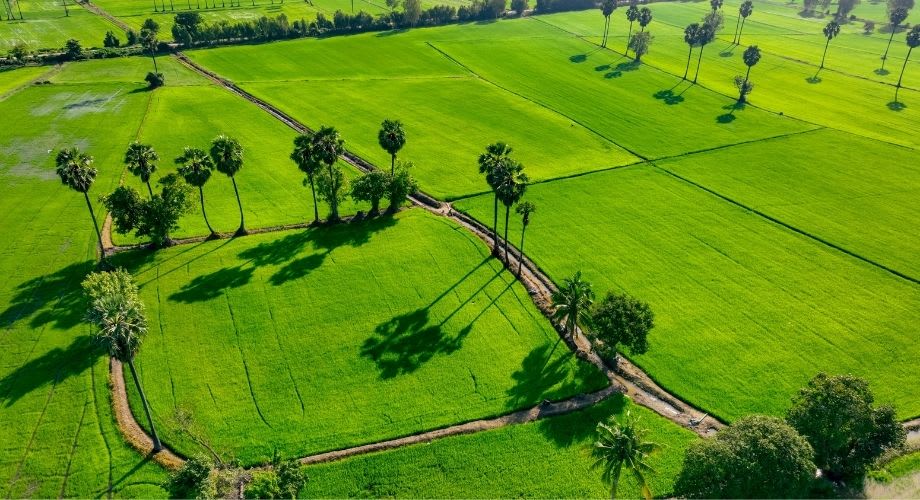
For a quieter, more authentic alternative, consider the small Tha Kha Floating Market, located 10km away in Samut Songkhram province (open on weekend mornings). Here, farmers still trade directly from their boats much as they have for generations, while a landscape of coconut and nipa palms lends the scene considerable bucolic charm.
Amphawa Floating Market
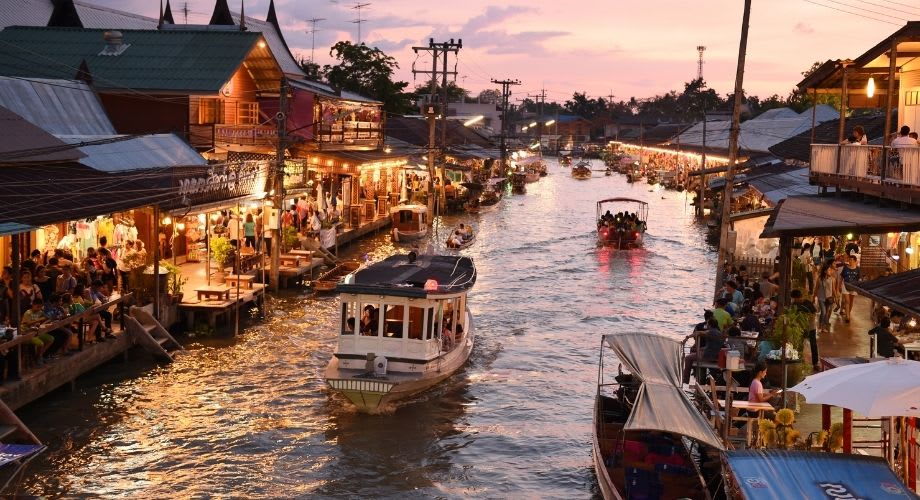
Unlike the other markets on this list, Amphawa—also in Samut Songkhram province—is less a standalone attraction than a genuine canal-side community, with roots stretching back to the 18th century.
Teakwood shophouses line both sides of the canal, their portraits of Thai royals and Taoist deities. Palm trees sway, temple roofs glisten, and the town as a whole offers a snapshot of how Thailand might have looked a century ago.
Amphawa also carries royal credentials: it was the birthplace of King Rama II, as well as his mother, the queen consort of Rama I.
Alas, the floating market—established in 2001—has shrunk in recent years. Where forty boats once gathered each weekend afternoon near the mouth of the canal, you’re now more likely to see just a few. While some lament the loss of tourism revenue, the quieter atmosphere allows visitors to explore this small but characterful town—with its wooden bridges and waterside cafés—without the impenetrable crowds.
The land-based market, however, remains lively, offering street food and local specialities such as palm sugar desserts and fried mackerel, caught locally.
Reduced tourism has also allowed Mae Klong’s famous firefly population to recover after years of decline. Boat tours depart after sunset from the main market and enter the nearby canals where the insects gather in the trees by the water’s edge. While it might not be Oxford Street on Christmas eve, the wavering flickering lights still enchant.
Beyond the market, the surrounding orchards and plantations are host to a number of homestays and agrotourism ventures. At the Chaipattana Conservation Centre, visitors can observe traditional palm sugar production or join workshops on Thai dessert-making using local ingredients. A short drive south brings you to the town of Mae Klong and its famous railway market, where several times a day trains squeeze through the stalls—another of Bangkok’s iconic sights.
Both Amphawa and Damnoen Saduak are popular stopovers en route to the seaside town of Hua Hin, and hotels such as Avani+ Hua Hin Resort, Anantara Hua Hin Resort, and the recently rebranded NH Hua Hin offer excellent bases from which to explore.