By Fraser Morton
Fraser Morton is an award-winning storyteller producing humanistic works across journalism reportage, documentary film, photography, digital and print art.

Picket Chabwedzeka, Victoria Falls Private Game Reserve Manager, briefs his Rhino Ranger Patrol unit.
It's just after dawn as Picket Chabwedzeka thunders his Land Cruiser along the dusty tracks through the bush, en route to meet his Rhino Patrol Team.
By 9 am each day, reserve manager Picket and his team track, locate and lay eyes on all black and white rhinos at Victoria Falls Private Game Reserve, in Zimbabwe. This is a matter of life and death for one of the world's most poached animals.
In 20 years, Picket and his team have pulled off a monumental feat: a zero poaching rate in a country and continent where black rhinos were driven to the brink of extinction.
Once abundant across sub-Saharan Africa, black rhinos remain Critically Endangered today.
Poaching decimated 96 per cent of their population between 1970 and 1990, and today, just over 3,000 mature individuals remain.
In the Zambezi Valley surrounding Victoria Falls, black rhinos were completely eradicated by around 1970 due to a total lack of law enforcement during the Bush War era.
Rhino Ranger Patrol unit. Photo by Fraser Morton.
Back From The Brink
The local reintroduction began in 2006 when the Victoria Falls Private Game Reserve received three black rhinos.
Today, the reserve holds both black and white rhinos. Surplus individuals were also translocated to repopulate other reserves in Zambia and Zimbabwe. Protecting this critically endangered species requires relentless surveillance and sustained black rhino conservation efforts.
Picket, an ecologist with degrees from Cape Town and Oxford, and his rangers complete daily inspections of the 32-kilometre perimeter fence to check that poachers haven’t breached the reserve boundary.
“If our patrol team wasn't here, these rhinos wouldn't last a day,” Picket said.
Each rhino must be tracked on foot by the ranger team through the bush, visually inspected for body condition, overall health and wellbeing, and logged every 24 hours.
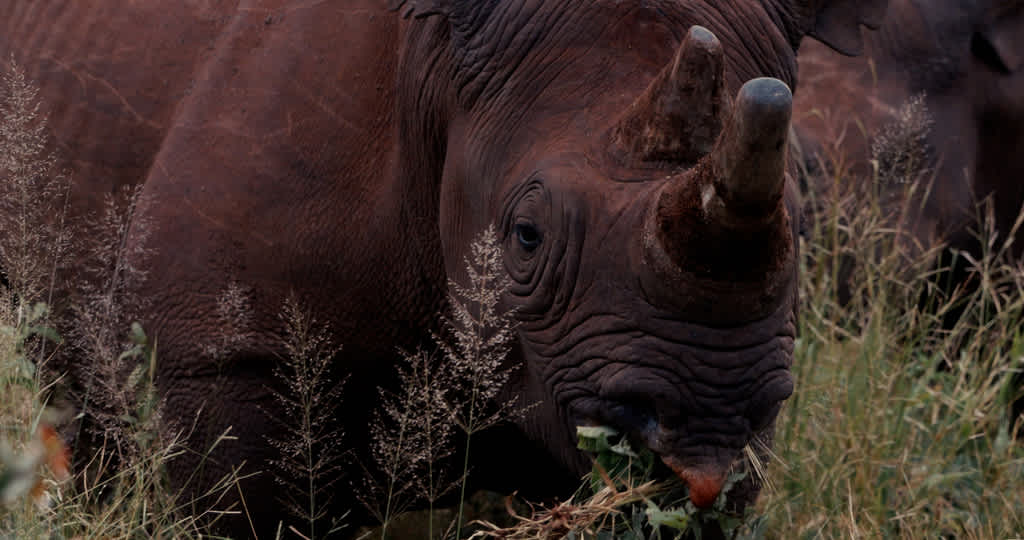
Still from the film Rhino Guardians by Fraser Morton.
Still from the film Rhino Guardians by Fraser Morton.
Fighting The Illegal Wildlife Trade
Being a ranger is a physical – and dangerous – job. They face poachers who can be armed and dangerous.
To maintain physical readiness, rangers undergo mandatory re-testing every 60 days, requiring them to complete a 10-kilometre run in under 45 minutes or a five-kilometre run in under 22 minutes, as well as 60 push-ups, 60 sit-ups, and 10 pull-ups.
Picket and his rangers risk their lives each day to protect these animals from armed poachers and a growing illegal wildlife trade, which is valued between US$7 and US$ 23 billion, according to the United Nations Environment Programme (UNEP) & INTERPOL. It is growing about five per cent each year.
The illegal wildlife trade is one of the largest transnational criminal enterprises alongside drugs, arms, and human trafficking. With the black market for rhino horn estimated to be worth hundreds of millions of dollars, trading between US$ 20,000 and US$ 65,000 per kilogram, a single horn can have a street value between US$ 60,000 and US$ 300,000.
International poaching and smuggling rings fuelled mainly from China and Southeast Asia drive the demand and use local poachers, complex smuggling routes and middlemen to ship goods out of Africa.
The largest driver of rhino horn trafficking is high-net-worth collectors in Asia, who buy carved goods and jewellery, seen as status symbols or store-of-value investments.
The Traditional Chinese Medicine industry is also a huge driver of illegal rhino horn.
Picket Chabwedzeka, Victoria Falls Private Game Reserve Manager, holds snare traps seized from poachers. Photo by Fraser Morton.
Protect Life By Any Means
Picket and the ranger team use many methods to deter poachers, including dehorning rhinos, which can save their lives.
Veterinary teams dart rhinos from a helicopter and dehorn them every three to four years. The animal is tranquilised, and the horn (made of keratin, or hair) is removed safely, above the skinline, which grows back naturally over time.
Picket and his ranger team then spread news of the dehorning through the media to further deter poachers from trying to try to enter the reserve. This is one of the most effective tools ranger teams have to support black rhino conservation and save rhinos' lives across Africa.
Poachers, meanwhile, use brutal tactics to obtain rhino horn. They either shoot the animal with live ammunition or a tranquilliser dart, then use machetes, chainsaws or other brutal methods to cut deep into the animal's skin tissue to remove every inch of horn.
This leads to a slow, agonising death, where the rhino dies from suffocation, blood loss, or infection. All are excruciating deaths, which Picket and his rangers work tirelessly to prevent.
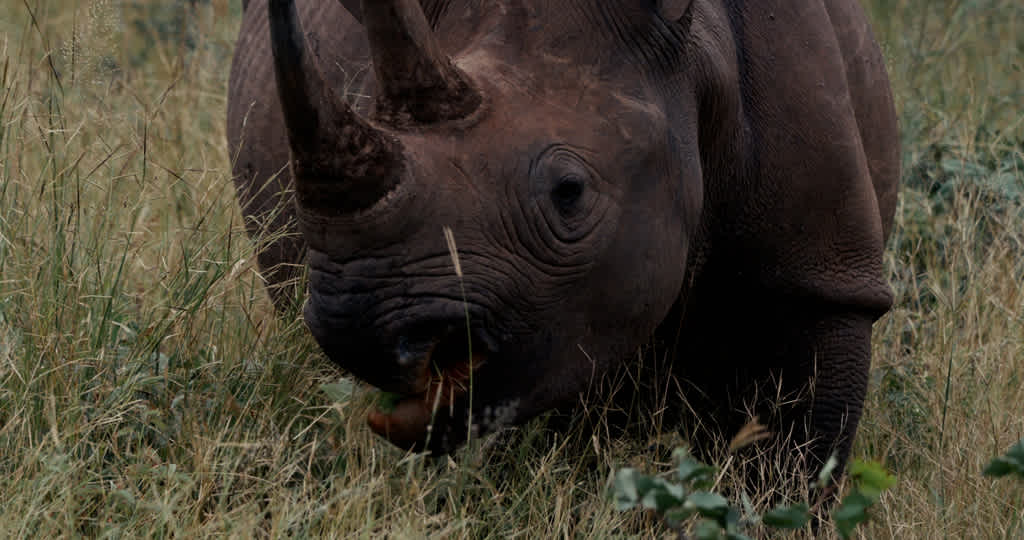
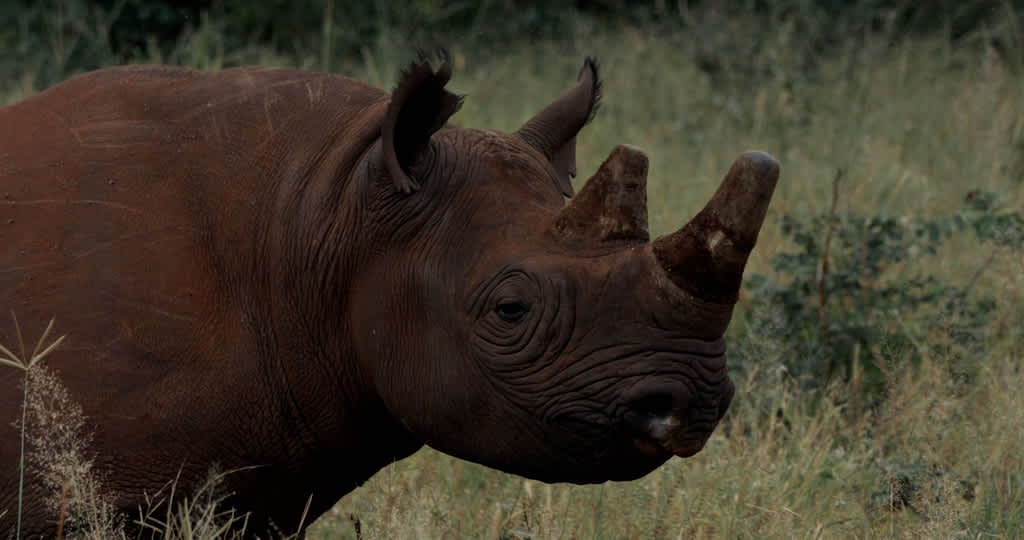
The black rhinos of Victoria Falls Private Game Reserve. Still from the film Rhino Guardians by Fraser Morton.
A Bond Across Species
Picket has developed a bond with the black rhinos at Victoria Falls Private Game Reserve that is more than protector. It’s more like friendship.
One day, a few years ago, Picket found himself standing face-to-face with a two-ton bull with an unpredictable temperament: a black rhino named Buster.
When Buster charged, Picket didn't raise a rifle, nor did he run. He held his ground behind an acacia tree, took a slow breath, and began to whistle.
The rhino’s ears twitched. The animal slowed its charge to a walk. The horn lowered back toward the dust.
“Slowly, I got the courage to move off from behind the tree and just stood in the open,” Picket recalled.
“The rhino looked at me, didn't chase me, and started to relax in my presence. He knew I wasn’t a threat.”
Since that day, the pair have formed a cross-species understanding. Buster even visits Picket’s home on the edge of the reserve, appearing at his back door. This is remarkable, considering black rhinos are considered extremely dangerous and aggressive animals because of their unpredictable temperament, poor eyesight, and powerful build.
“Buster knows we are there to protect him,” Picket said.
As dusk bleeds into deep night over the reserve, Picket sits in silence in his Land Cruiser watching Buster and three other black rhinos grazing yards away.
“We hope one day eventually there won’t be any need to carry guns,” Picket says.
“That we can stop this illegal wildlife trade, and that people realise that we need to keep these majestic animals alive.”

.jpg)
.jpg)
.jpg)